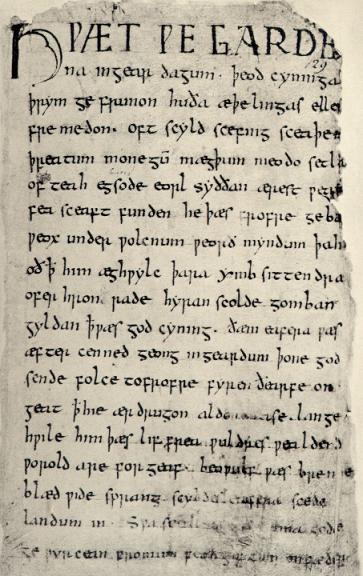
There are many pieces of literature that have been written down through the course of time. Many of these pieces were written in Europe, and depict epic quests and fantastic journeys. The earliest piece of European literature ever printed was a piece of Anglo Saxon poetry known as Beowulf. The Anglo Saxons were a Germanic tribe that had many values and ideas that their people lived by and kept sacred in their day to day lives. These values include; bravery, loyalty, generosity, and heroism. Beowulf, the main character in the poem Beowulf is the man who has all of these values, and is the epitome of the Anglo Saxon.
Beowulf is the image of bravery throughout the story Beowulf, and there are two examples from the story that depict his bravery best. The night Beowulf fights Grendel, before the actual fight Beowulf claims that he will fight Grendel without his sword or his armor, nothing but his bear hands against Grendel’s hell forged claws. In the end Beowulf prevails due to Grendel’s hide being impervious to swords, but Beowulf making the claim that he would willingly fight Grendel without a sword prior to the knowledge exhibits Beowulf’s bravery. Another example from the story that demonstrates Beowulf’s bravery is towards the end of the poem when Beowulf must face the dragon that is terrorizing his people. He knew going into the battle that he was getting old, and that this would most likely be the last battle he would ever fight. Beowulf did slay the dragon in the end, but his premonitions were true; Beowulf died from the venom in the dragon’s fang, and won his last battle. Beowulf knowing that he was going to die in this battle, yet still following through in his intent to fight clearly portrays his bravery.
Beowulf is the image of bravery throughout the story Beowulf, and there are two examples from the story that depict his bravery best. The night Beowulf fights Grendel, before the actual fight Beowulf claims that he will fight Grendel without his sword or his armor, nothing but his bear hands against Grendel’s hell forged claws. In the end Beowulf prevails due to Grendel’s hide being impervious to swords, but Beowulf making the claim that he would willingly fight Grendel without a sword prior to the knowledge exhibits Beowulf’s bravery. Another example from the story that demonstrates Beowulf’s bravery is towards the end of the poem when Beowulf must face the dragon that is terrorizing his people. He knew going into the battle that he was getting old, and that this would most likely be the last battle he would ever fight. Beowulf did slay the dragon in the end, but his premonitions were true; Beowulf died from the venom in the dragon’s fang, and won his last battle. Beowulf knowing that he was going to die in this battle, yet still following through in his intent to fight clearly portrays his bravery.

Beowulf also displays his generosity and loyalty throughout the story. When Hrothgar gives treasures to Beowulf for defeating Grendel and Grendel’s mother, Beowulf generously distributes the riches around to all of his remaining men. This can be seen as generosity because none of his men did anything to help contribute to the annihilation of Grendel or Grendel’s mother. Another generous act of Beowulf’s was when the Geats were leaving Denmark he gave the guard watching the boat an ancient sword which immediately elevated the guard up to warrior status. When the Geats finally returned home Beowulf gave the remaining treasure to his king, Higlac. This demonstrates that Beowulf is generous enough not to keep the remaining treasure for himself, and that he is loyal to his king.
Beowulf being the main character of the story is also the hero. The definition of a hero is “A man of distinguished courage or ability, admired for his brave deeds and noble qualities.” Beowulf is undoubtedly comprised of all of these qualities and clearly falls under the category of a hero. Beowulf has inimitable courage, and has incredible abilities that can be matched by no other man; such as immense strength and the ability to hold his breath underwater for hours on end. Beowulf is admired by all; his name is heard all around the world. His brave deeds such as the defeat of Grendel, Grendel’s mother, and the fierce dragon all contribute to his fame and his heroic status. Selflessness is a quality that a hero must also possess; a hero must put the needs of the many before themselves. Beowulf shows his selflessness when he dies in battle fighting the dragon that was terrorizing his people.
Beowulf embodies the ideas and values of Anglo Saxon life. Beowulf displays bravery when he willingly goes to battle with demons and dragons. Generosity and loyalty are also revealed as some of Beowulf’s when he divides his riches among his men and pays homage to his king with the riches that were rewarded to him from Hrothgar for the defeat of Grendel. Beowulf also displays heroism when he puts himself in danger and fights for the good others, instead of for personal gain. These are the values Beowulf upholds, and are the values of Anglo Saxon life.
